
About the journal
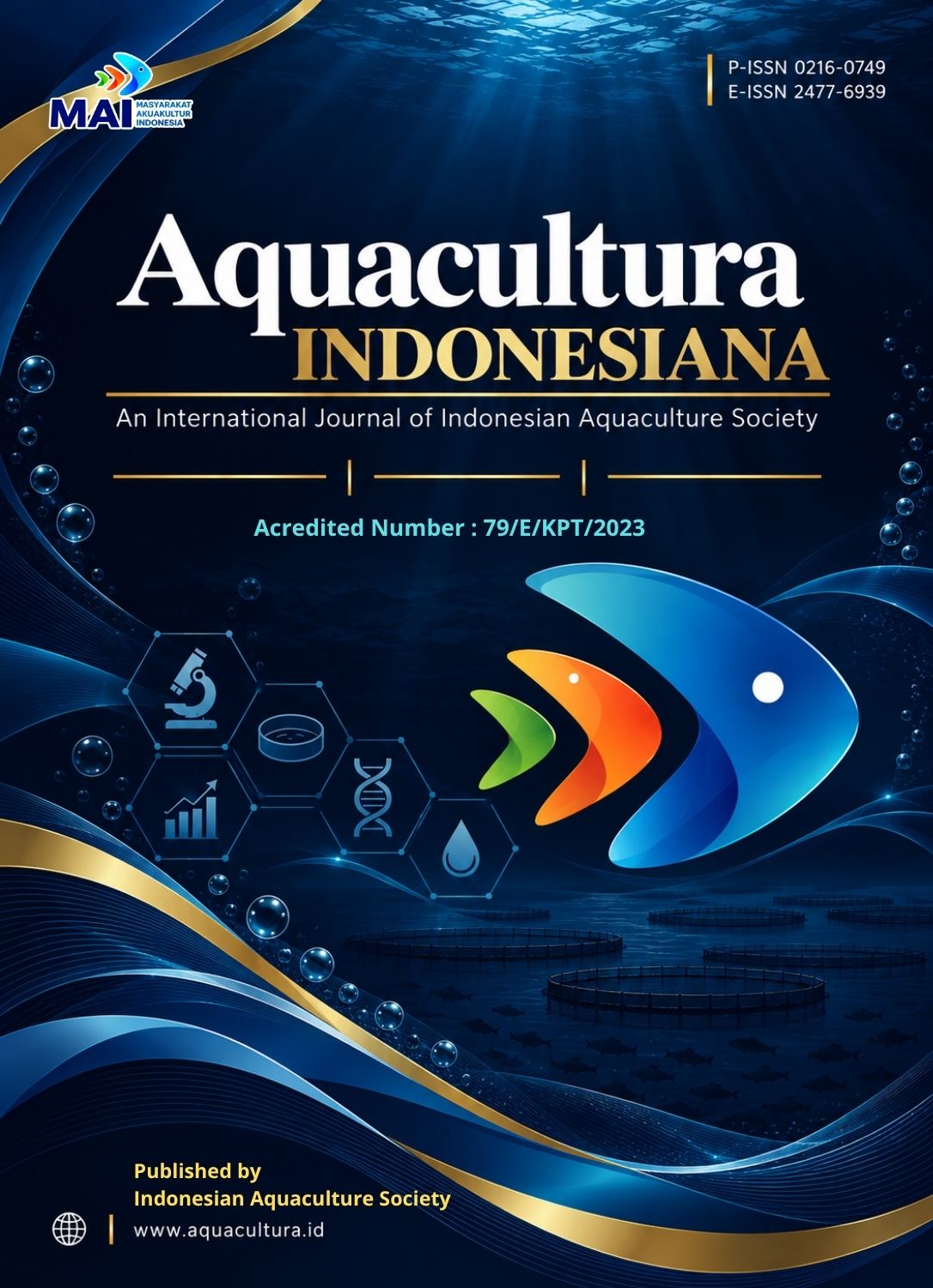
About the Journal
Aquacultura Indonesiana (E-ISSN: 2477-6939) is an international scientific journal published by the Indonesian Aquaculture Society (Masyarakat Akuakultur Indonesia/MAI). The journal serves as an academic platform for researchers, academics, practitioners, policymakers, and other stakeholders to disseminate scientific knowledge, innovative research findings, and technological developments in aquaculture and related aquatic sciences, with particular emphasis on tropical aquaculture.
Aquacultura Indonesiana publishes peer-reviewed original research articles, short communications, and review papers in both Indonesian and English. The journal aims to promote scientific excellence, encourage interdisciplinary collaboration, and support the development of sustainable, productive, resilient, and environmentally responsible aquaculture systems at local, national, and international levels.
Publishing Schedule
Aquacultura Indonesiana is published biannually, with two issues released each year, in April and October. Each issue features peer-reviewed scientific articles covering original research, short communications, review articles, and other scholarly contributions relevant to tropical aquaculture and related aquatic sciences.
The journal follows a regular publication schedule to ensure the timely dissemination of scientific findings and promote the advancement of aquaculture research and sustainable practices. Manuscripts are accepted throughout the year and are subject to editorial assessment and peer review. Accepted manuscripts are published in the appropriate issue according to the journal’s editorial schedule.
Focus and Scope
The journal welcomes scientific contributions covering fundamental and applied research in tropical aquaculture and related fields, including but not limited to:
-
Aquaculture Systems and Production Technologies: Freshwater, brackishwater, and marine aquaculture; pond culture; cage culture; recirculating aquaculture systems (RAS); integrated aquaculture; biofloc technology; and other innovative production systems.
-
Aquatic Animal Biology and Genetics: Aquatic animal physiology, anatomy, reproduction, breeding, genetics, genomics, selective breeding, growth performance, and the development of improved aquaculture species.
-
Aquaculture Nutrition and Feed Technology: Nutritional requirements, feed formulation, feed quality, alternative feed ingredients, functional feeds, live feeds, feed additives, feed efficiency, and the utilization of locally available resources for sustainable aquaculture nutrition.
-
Aquatic Animal Health and Disease Management: Aquatic animal pathology, parasitology, microbiology, immunology, disease diagnosis, disease outbreaks, epidemiology, biosecurity, prevention and control strategies, and the development of health management technologies.
-
Water Quality and Aquatic Environment: Water quality management, aquatic pollution, environmental degradation, carrying capacity, nutrient cycling, waste management, sediment quality, and the environmental impacts of aquaculture activities.
-
Sustainable Aquaculture and Environmental Management: Sustainable production practices, ecosystem-based aquaculture, integrated multi-trophic aquaculture (IMTA), resource efficiency, circular economy approaches, biodiversity conservation, and environmentally friendly aquaculture technologies.
-
Seaweed and Aquatic Plant Aquaculture: Cultivation, physiology, genetics, propagation, productivity, disease management, post-harvest handling, and the development of value-added products from seaweed and other aquatic plants.
-
Ornamental Fish and Aquatic Biodiversity: Ornamental fish breeding, larval rearing, nutrition, health management, genetic improvement, aquatic biodiversity, and the sustainable utilization of aquatic organisms.
-
Climate Change and Global Environmental Challenges: The effects of climate change, global warming, ocean acidification, extreme weather events, salinity fluctuations, and other environmental changes on aquaculture productivity, aquatic organisms, and production systems, including adaptation and mitigation strategies.
-
Aquaculture Engineering and Technological Innovation: Aquaculture infrastructure, equipment, automation, sensor-based monitoring, digital technologies, artificial intelligence, precision aquaculture, and innovative approaches to improving production efficiency and environmental performance.
-
Post-Harvest Technology and Aquaculture Product Quality: Harvesting techniques, handling, processing, product quality, food safety, value addition, and the development of aquaculture products and by-products.
-
Socioeconomic Aspects and Aquaculture Development: Aquaculture economics, business management, value chains, market development, policy analysis, community-based aquaculture, farmer empowerment, and the socioeconomic dimensions of sustainable aquaculture.
The journal also welcomes interdisciplinary studies that connect aquaculture with environmental science, biotechnology, food security, blue economy development, and sustainable use of aquatic resources.
Types of Articles
Aquacultura Indonesiana considers the following categories of scholarly contributions:
-
Original Research Articles: Reports of original scientific investigations presenting clear research objectives, appropriate methodologies, reliable results, and meaningful contributions to aquaculture science and practice.
-
Short Communications: Concise reports of significant findings, preliminary research results, innovative methods, or observations that warrant timely dissemination.
-
Review Articles: Critical and comprehensive evaluations of existing literature that synthesize current knowledge, identify research gaps, and propose directions for future research.
All submissions must be original, scientifically sound, relevant to the journal's focus and scope, and prepared in accordance with the journal's author guidelines.
Peer Review and Publication Ethics
Aquacultura Indonesiana is committed to maintaining high standards of scientific quality, academic integrity, and publication ethics. Submitted manuscripts are subject to an initial editorial assessment to evaluate their suitability for the journal. Manuscripts that meet the initial requirements are then evaluated through a peer-review process involving qualified reviewers with relevant expertise.
Editorial decisions are based on the manuscript's originality, scientific rigor, methodological appropriateness, clarity of presentation, relevance, and contribution to the field. Authors are expected to comply with accepted standards of research integrity, proper citation, authorship, conflict-of-interest disclosure, and responsible reporting of research findings.
The journal seeks to ensure that editorial decisions are made fairly, objectively, and independently, in accordance with its applicable editorial policies and publication ethics guidelines.
Open Access Policy
Aquacultura Indonesiana is an open-access journal that provides readers worldwide with free access to its published articles. The journal supports the broad dissemination of scientific knowledge to facilitate research, education, innovation, and the practical application of aquaculture science.
Readers may access published research without subscription barriers, subject to the applicable copyright and licensing terms specified by the journal. Any reuse, distribution, or reproduction of published material must comply with the relevant license and attribution requirements.
Aim and Contribution
Through the publication of high-quality scientific research, Aquacultura Indonesiana aims to contribute to the advancement of aquaculture science, the improvement of production technologies, the protection of aquatic environments, and the sustainable development of the aquaculture sector.
The journal encourages contributions from national and international researchers and promotes the exchange of knowledge across disciplines and geographical regions. By connecting scientific research with practical applications, the journal seeks to support innovation, strengthen aquaculture resilience, improve resource efficiency, and contribute to global food security and sustainable blue economy development.